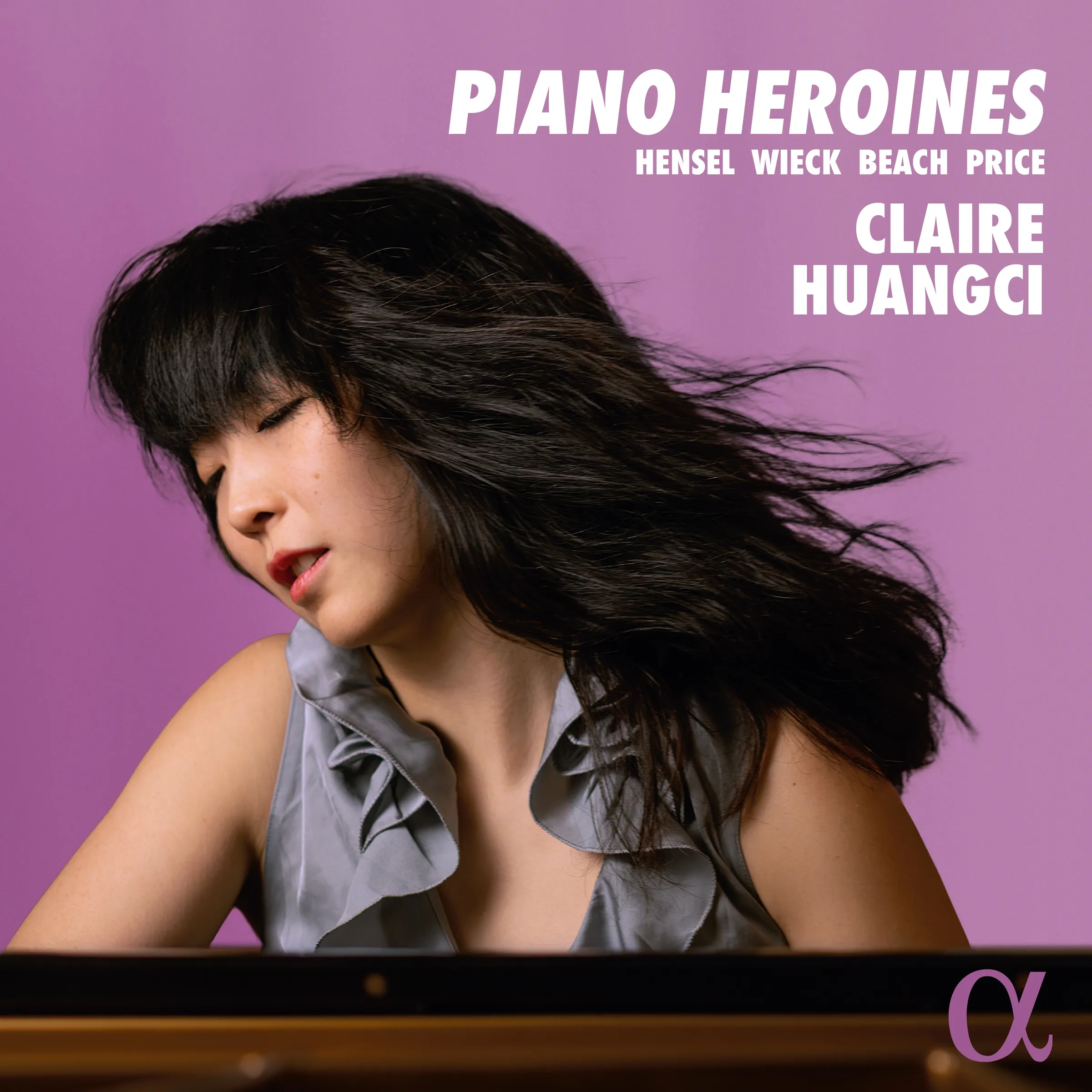
Piano Heroines
Works by Fanny Mendelssohn (Hensel), Amy Beach, Clara Schumann, Florence Price
Press
“A superb album, smartly programmed and brilliantly played.”
“'Fireflies' is beguiling - as is Huangci's liquid touch.”
Booklet & images
Tracklist
- 1Fanny Mendelssohn: Capriccio in B Minor, H. 349, H. 349 — I. Andante1:31
- 2Fanny Mendelssohn: Capriccio in B Minor, H. 349, H. 349 — II. Allegro molto3:58
- 3Fanny Mendelssohn: Das Jahr, H. 385, H. 385 — No. 2, February. Scherzo2:42
- 4Fanny Mendelssohn: Das Jahr, H. 385, H. 385 — No. 5, May. Frühlingslied2:28
- 5Fanny Mendelssohn: Das Jahr, H. 385, H. 385 — No. 6, Juni. Serenade4:44
- 6Fanny Mendelssohn: Das Jahr, H. 385, H. 385 — No. 9, September. Am Flusse2:42
- 7Amy Beach: Fantasia Fugata, Op. 87 — I. Allegro vigoroso1:54
- 8Amy Beach: Fantasia Fugata, Op. 87 — II. Fuga. Allegro moderato3:16
- 9Amy Beach: Cradle Song of the Lonely Mother, Op. 1083:56
- 10Amy Beach: Four Sketches, Op. 15 — No. 1, In Autumn2:09
- 11Amy Beach: Four Sketches, Op. 15 — No. 2, Phantoms1:47
- 12Amy Beach: Four Sketches, Op. 15 — No. 3, Dreaming4:29
- 13Amy Beach: Four Sketches, Op. 15 — No. 4, Fire-Flies2:48
- 14Clara Schumann: Soirées musicales, Op. 6 — No. 2, Notturno3:57
- 15Clara Schumann: Quatre pièces caractéristiques, Op. 5 — No. 2, Caprice à la Boléro3:26
- 16Clara Schumann: Quatre pièces caractéristiques, Op. 5 — No. 4, Scène fantastique4:12
- 17Clara Schumann: Piano Concerto in A Minor, Op. 7 — II. Romanze (with Tristan Cornut, cello)3:40
- 18Clara Schumann: Soirées musicales, Op. 6 — No. 6, Polonaise3:13
- 19Florence Price: Fantasie Nègre No. 2 in G Minor6:24
- 20Florence Price: Meditation2:14
- 21Florence Price: Waltz of the Spring Maid3:12
- 22Florence Price: Your Hands in Mine2:59
- 23Florence Price: Cotton Dance3:04
From the booklet
HEROINES — BY CLAIRE HUANGCI
What defines a musical heroine? Is it the depth of expression, the strength of voice, or the determination to be heard in a world that often resisted them?
This album grew from a first impression back in 2019, when I learned Clara Schumann’s piano concerto in celebration of her 200th birthday. Her boldness and clarity as a young composer struck me immediately, and I was drawn to explore more of her piano oeuvre. The idea gradually expanded into a wider project around four remarkable women: Fanny Hensel, Clara Schumann, Amy Beach, and Florence Price. My choice extends beyond their personal circumstances and even their music; having been born and educated in the U.S. and living in Germany since 2007, the pairing of two Americans and two Germans reflects a kind of mirror to my own artistic journey.
Though all four come from the Romantic tradition, their compositional languages are distinct. Each not only left behind rich and inventive piano works, but helped shape the possibilities of women in music history. In their music, we don’t just hear history. We hear transformation.
Fanny Hensel’s style often parallels that of her brother Felix Mendelssohn – elegant, quicksilver, and lyrical. Her Capriccio bursts with spontaneity, while selected months from her suite The Year offer both intimacy and brilliance. Learning these works, I often found myself smiling, recognizing familiar turns of phrase and musical quotations before she molds them into something uniquely her own.
Clara Schumann’s youthful works, written during a time of close artistic exchange with Robert Schumann, reveal a confident voice and exceptional pianism. The selected miniatures offer a range of character and color, from the dramatic to the refined. A special track is the second movement of her piano concerto – a heartfelt duet with cello that begins with a solitary piano and ends in soaring harmony.
I only began exploring Amy Beach’s music recently, and it was a revelation. After recording her Variations on Balkan Themes, I turned to her shorter works. Four Sketches had me hooked from the first sight-reading – especially Fire-Flies, clearly inspired by Liszt’s Feux Follets, a student favorite of mine. The Fantasia Fugata, a nod to Scarlatti, is prefaced with a playful note of thanks to the family cat, Hamlet, for “attempting” to inspire a fugue theme.
Florence Price’s voice blends Romantic warmth with the rhythms and colors of African American folk idioms. Her solo pieces – lyrical, spirited, and stylistically diverse – carry the same emotional immediacy as her concerto. Fantasie Nègre 2, Cotton Dance, Meditation, and Your Hands in Mine offer different windows into a composer who wrote with both pride and resilience.
The realities these women faced are difficult to imagine for any modern woman in the field. Clara Schumann was a mother of eight and the main breadwinner, constantly touring. Fanny Hensel composed largely in private, often publishing under her brother’s name. Amy Beach’s career was practically silenced during her marriage; only upon her husband’s death did she return to the stage. Florence Price faced both racial and gender discrimination and later raised two children alone. Their music exists not just in spite of their circumstances, but often because of them.
That tension between personal life and artistic ambition still echoes today. I recorded this album during a sweltering July 2025 – just weeks before the birth of my second child. There was weight in every sense: physical, emotional, and musical. Somehow, it felt appropriate. These composers carried so much, and despite everything, still gave the world their music. Heroines is my way of listening back – and adding my voice to theirs.
WOMEN IN THE ARTS — BY NICOLAS DERNY
Fanny Hensel, the sister of Felix Mendelssohn-Bartholdy, although unable to compose professionally because of her social status, contimued to do so on a more intimate level. Whilst her musical outlook was progressive, she did not particularly feel she had strength enough to develop her ideas in larger forms. It was because of this, she told her brother Félix on 17 February 1835, that she felt attracted to smaller structures and to the art song or Lied in particular. She set down a musical description of each month of the year in Das Jahr, a suite for piano and Christmas present for her husband Wilhelm, in 1841 – thirty-five years before Tchaikovsky wrote his own The Seasons. Also a suite for piano.
Should we regard these as Epinal prints for a musical calendar? Hensel revised the manuscript the following year, introducing each musical vignette with an excerpt from German poetry and with illustrations by her painter husband. There were those who saw these sketches as evocations of moments from her own life: February, for example, seems to evoke impressions of the Roman carnival from the six months she spent in the city in 1839-40, during which time she met Gounod and Ingres and composed the Capriccio H 349. This work does not seek to conceal its stylistic similarity to her brother’s music; it even seems to foreshadow Felix’s own Op.67 No.4 (1845).
A fresh and graceful May arrives in luminous A major with a theme that first appeared in the sombre January and recurs as a leitmotif throughout the work. The first version of June is given here, in which three hands seem to serenade the listener: the melody is entrusted to the middle register, with a bass line on the left and arpeggios on the right (bars 88-118). This technique was popularised by Thalberg and is also used in September, a musical interpretation of Goethe’s An der Mond (Fliesse, fliesse, lieber Fluss! Nimmer werd‘ ich froh). The semiquavers of this Andante con moto in a sad B minor depict the water’s flow and its interruptions.
Fräulein Wieck
Clara Wieck did not need to wait for her husband Robert Schumann to urge her to put her own creations down on paper. She was ten years old when her op. 1 was published, and sixteen when she began the Caprice à la Boléro – its rhythmic motif on a repeated note has nothing particularly Spanish about it – and the Ballet des Revenants with its hallucinations and a macabre dance of the will-o’-the-wisps. The Notturno (quoted by Robert in his Novelette Op.21 No.8) and the Polonaise from the Soirées musicales Op.6 were composed at the same time and openly flirt with Chopin. The same is true for the Piano Concerto Op.7, from which we may easily believe that the dialogue between the keyboard and cello that lies at the heart of the Romanze would later inspire the Andante of Brahms’ Op.83. The life of a wife, mother, and performer would later lead Clara to neglect composing and then to abandon it, convinced that a woman could not compose like a man.
From the New World
Amy Marcy Cheney was extremely talented and gave her first piano recitals at the age of seven, including one or two of her own pieces in her programmes. She went on to complete her training in Boston with Ernst Perabo and Carl Baermannn, themselves pupils of Moscheles and Liszt respectively. Her solo career had barely begun in 1886 when it was abruptly interrupted by her marriage to Dr Beach, twenty-four years her senior. Apart from the occasional charity concert, the only musical activity allowed her was composition – she was later to express a certain gratitude to her husband, whose dictum had compelled her to develop her compositional skills.
As with Hensel’s work, each of her Four Sketches (Op.15, 1892) includes an epigram. In Autumn is based on Lamartine (Feuillages jaunissants sur les gazons épars) only to take the opposite tack: where Lamartine presents autumn as a passage from life to death, Beach creates light variations on the colours of the season when the leaves fall undulating in the wind. Phantoms, marked allegretto scherzando and preceded by a phrase from Victor Hugo (“Toutes fragiles fleurs, sitôt mortes que nées”), dances without a thought of the Grim Reaper who, in Hugo’s Les Orientales, took a young girl as she left a ball.
“Tu me parles du fond d’un rêve”. This line from Hugo’s Les Contemplations is the heading for Dreaming, a lullaby that Rachmaninov might not have disowned, but one that is much less strange and restless than Beach’s later Cradle Song of a Lonely Mother (1924). Fireflies is preceded by “Mourir avec le printemps, mourir avec les roses”, a line from Lamartine’s Méditations poétiques. We hear echoes of Liszt (Feux follets) and of Chopin (Étude Op.25 No.6) in this final page that, according to Beach herself, “shimmers and blinks and twinkles as did the profusion of fire-flies one summer”. Virtuosity remains the order of the day in Fantasia Fugata (1923). For those who believe in legends, everything here is based on notes played when Beach’s cat was placed on the keyboard, like Scarlatti’s cat of old (Sonata K 30).
Black Power
A mixed-race woman from Arkansas, Florence Price’s career was hampered by sexism and racism. Although not completely unknown, she wrote much more than was performed and published during her lifetime. She had moved to a house in Illinois in 1926 and many of her manuscripts were only found there in 2009. Often undated, these autographs are sometimes difficult to place; only a graphological study can link the Meditation to an Andante con espressione for violin and piano that was completed at the end of June 1929. One might think that the Waltz of the Spring Maid composed a little later is free of the Afro-American elements – real melodies or her own turns of phrase – that are the composer’s hallmark, but that would be to ignore certain harmonic colours.
Price set three of her four Fantaisies nègres (1932), including No.2 in G minor, somewhere between evocations of spirituals, work songs and European virtuosity. The Cotton Dance was probably written at the turn of the following decade and alludes to Shortnin’ Bread, a plantation song that had returned to public consciousness in a recording by the Andrews Sisters in 1938. On a more autobiographical note, Price made four settings of Your Hands is mine, a generously romantic romance originally called Memory Lane. The change of title is no doubt explained by the fact that the last two versions date from her last love affair in the early 1940s.